Over 50 years ago, Martin Cooper made the first call on a mobile phone using his Motorola DynaTAC 8000X. And ever since then, every field and walk of life now has its portable mobile version: mobile banking, mobile learning, and mobile healthcare, aka mHealth.
Healthcare app development is now an indispensable part of how modern care is delivered. The speed at which the healthcare industry is going digital requires a healthcare mobile app development company as a key partner of any healthcare organization.
But healthcare app development is entirely different from other industries. Moreover, advancements in AI and stricter regulatory compliance are making the use of mobile technology in healthcare more complex than before. Therefore, before searching for healthcare mobile app development services, you must know all the ins and outs of healthcare app development in 2026.
We’ve been working with healthcare companies for over two decades. So, we’ve gathered all the relevant information you need about healthcare app development in 2026 in this blog.
A brief timeline of mHealth
Pagers are what you can call the first popular “mobile” devices in healthcare. There was a time when doctors and healthcare workers carried them everywhere for instant communication.
However, if we are more pedantic, modern mobile healthcare started exactly in 2003 because it was the year when the word “mHealth” was coined in a paper. A year later, another paper defined and explained what mHealth is in a structured way. In 2006, the first book on mHealth was published under the title “M-Health Emerging Mobile Health Systems.”
The next big milestone came in 2008 when Apple launched its App Store for the iPhone. Just three months after its launch, the WebMD Symptom Checker healthcare app was released on the platform, and it reached 1.5 million downloads by the end of 2009.
The 2010s were all about wearables in mHealth. Healthcare app development was focused on integrating mobile apps with wearables, like monitoring devices and fitness tracking sensors. It was largely possible due to the introduction of 4G technology, which made real-time data processing easier. That is why 4G-health is generally considered to be a significant trend within mHealth.
The first half of the 2020s was the era of telehealth apps. Yes, it sounds like a cliché, but the COVID-19 pandemic really exploded the use of virtual care and remote monitoring platforms. As we approach the end of 2025, AI is the next frontier in healthcare app development. Healthcare apps are now expected to span a number of domains through AI with increasing clinical accuracy.
What’s different about healthcare app development?
Developing a healthcare app is different because, unlike most other apps, getting it wrong can hurt someone, literally.
1. Lives are at stake
If you build a food delivery app and it fails, someone might miss their meal. It will obviously make them hungry, might frustrate them, but it won’t kill them. But if you build a healthcare app and it fails, someone may take the wrong action that can adversely affect their well-being. That’s the first difference.
2. Evidence and trust
The second difference is that trust arrives before convenience in healthcare app development. Most apps earn the trust of the user by being useful. Healthcare apps must deserve trust before they’re used at all. They deal in symptoms, diagnoses, and fears, which means people assume authority even when none is claimed. Every button, word, and default option matters in a healthcare app.
3. Compliance
Next comes regulatory compliance. A healthcare mobile app development company works in an environment where rules are followed religiously, and they are written by people who don’t really understand or care about technology. HIPAA, FDA, and GDPR are like the Ten Commandments of healthcare, and going against them is sacrilegious in the field.
4. Data and privacy
Data in healthcare is more than just “user information” because it contains someone’s intimate details in numbers. Heart rates, medications, and medical history are confessions that patients make to their providers. Lose them, misuse them, or monetize them carelessly, and you haven’t just violated policy. You’ve broken a social contract that predates software.
The crux of everything above is that what makes healthcare apps unique is the responsibility. The technologies remain mostly the same, but they need to be balanced with caution and morality.
Types of healthcare apps
A healthcare mobile app development company isn’t just a one-trick pony. They create healthcare apps based on who will be using them and what problems they are trying to solve.
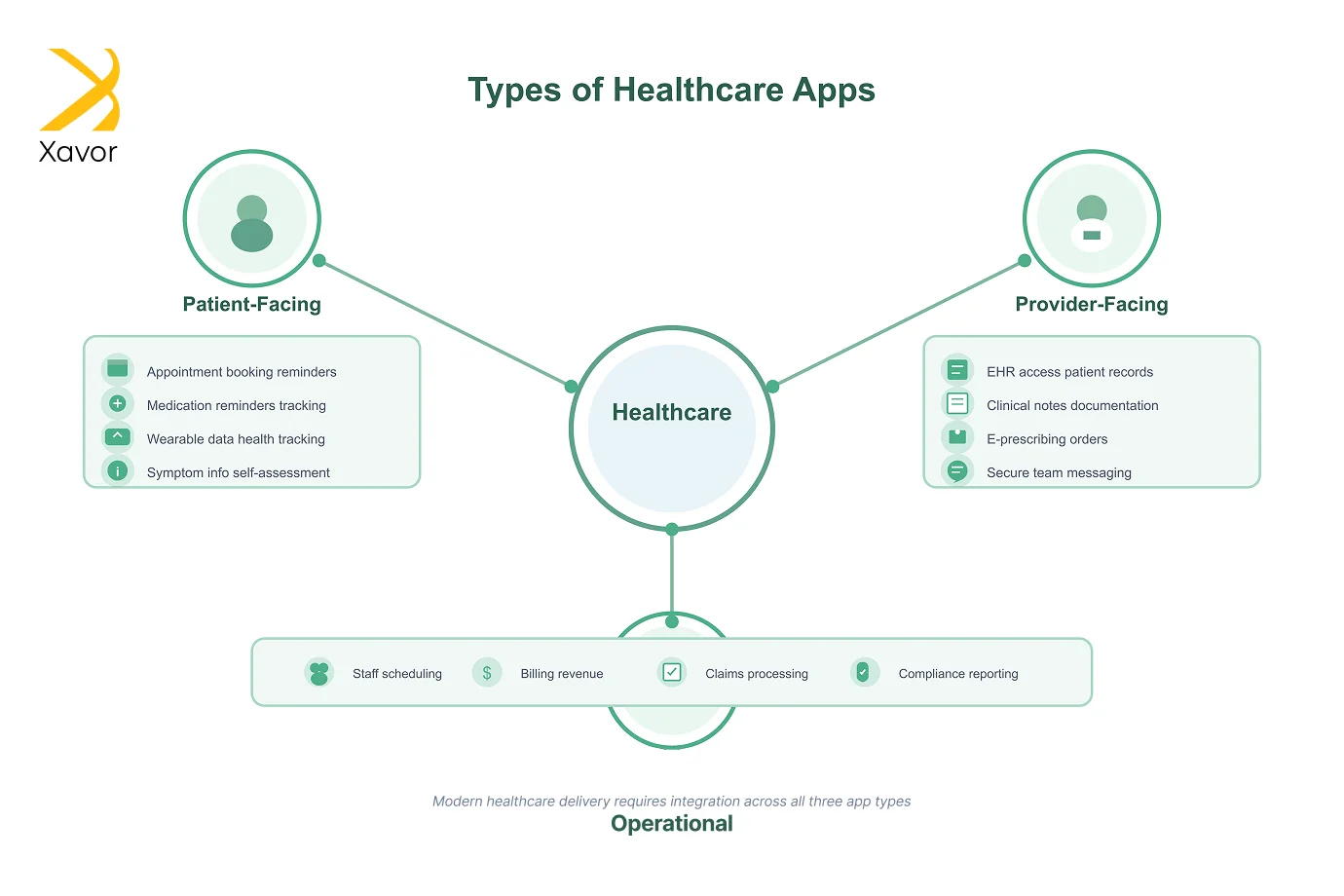
Understanding this early will save you time, money, and confusion later.
1. Patient-facing apps
In plain language, patient-facing apps help people reach care, understand their own health, and remember what their doctor told them when they’re feeling under the weather.
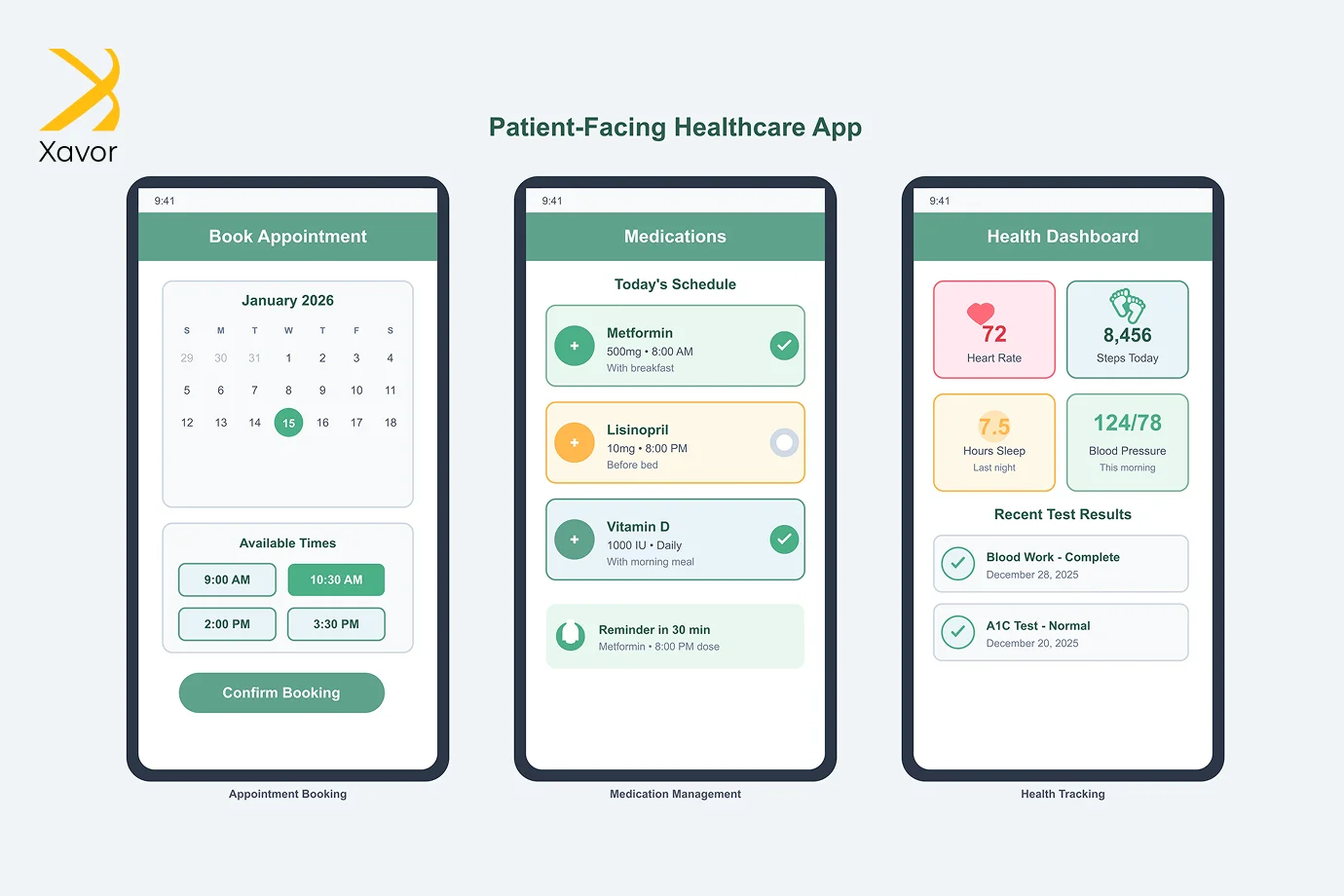
Patient-facing healthcare apps do things like:
- Let patients book appointments and receive reminders
- Show test results and health records
- Remind people to take medication
- Track health data from wearables or home devices
- Answer basic health questions
These apps are designed to be easy-to-use, reliable, and available at all times.
2. Provider-facing apps
Provider-facing apps are built to aid healthcare professionals in their daily workflows. These apps are designed to integrate with existing clinical systems. Doctors, nurses, and paramedical staff use them to do some of the following tasks:
- Accessing and updating medical records
- Writing clinical notes
- Managing tasks and coordinating care
- Prescribing medications
- Communicating securely with other clinicians
Since users of these apps are healthcare workers, they favor stability, integration, and results over visuals or creativity.
3. Operational apps
Operational healthcare apps are absolutely necessary to handle the machinery behind patient care, such as:
- Scheduling staff and managing shifts
- Processing billing, claims, and insurance
- Tracking compliance and regulatory reporting
Patients rarely interact with or even see these systems. But they certainly notice their importance when they fail.
Operational apps must be secure, auditable, and able to explain themselves to regulators, accountants, and IT teams. These apps are designed with functionality as the core objective, not necessarily innovation or thinking out of the blue.
Exploring opportunities for healthcare app development
Hiring a healthcare mobile app development company for your hospital or clinic is one of the best decisions you can make. The healthcare industry is increasingly digitizing with each passing year. It is estimated that by 2030, the global healthcare market will reach $800 billion.
And it isn’t just a bubble like in some historical cases. There are tangible, real-world benefits of healthcare apps for both providers and patients.
For healthcare providers
A healthcare app is a practical tool for healthcare providers to save time, improve care, and help organizations grow without breaking themselves in the process.
1. Less admin work
The reality is that clinicians often spend a large chunk of their day on administrative tasks. Mundane paperwork like documentation and routine reports takes up a lot of time that is better spent on patient care. Healthcare apps can cut a meaningful portion of that burden, which means more time for patients and less burnout for staff.
2. Better decision-making
Using EHR software development, provider apps can pull data from EHRs, labs, and other disparate systems into a unified place. In this way, clinicians aren’t hunting through multiple systems.
Moreover, integrating AI technologies can spot patterns sooner, triage faster, and make decisions with more confidence. Data-driven healthcare organizations consistently show measurable improvements in outcomes.
3. Reduced operational costs
Running a healthcare organization can be expensive, but it doesn’t have to be. Small inefficiencies in healthcare workflows accumulate to increase costs for providers. Healthcare apps reduce waste in subtle but notable ways, such as:
- Fewer missed appointments
- Better staffing and scheduling
- Less duplication in tests and procedures
- More care is handled remotely when appropriate
Telehealth apps and remote monitoring can also reduce unnecessary in-person visits, saving money without lowering quality.
4. Stronger compliance
As we mentioned earlier, healthcare is heavily regulated. Ensuring that you’re compliant with the myriad regulatory bodies is not so easy. Sometimes, healthcare organizations end up violating rules unintentionally. But modern healthcare apps help providers meet requirements like HIPAA, GDPR, and PDPA through built-in safeguards.
5. More scalability
Normally, healthcare scaling means more staff, more space, and more cost. Healthcare apps change that. Providers can expand services without increasing overhead at the same rate. This makes growth more sustainable and improves reach without overloading teams.
For patients
Traditional healthcare treats patients as passive recipients of care. But that is now changing with patient engagement becoming more and more important. And healthcare apps are a key way to make patients active participants in their own health.
1. Hassle-free care
Patient apps make it easier for patients to get help without the usual friction. People can book appointments online and use digital triage to figure out what kind of care they need.
This is especially helpful for older adults, rural communities, and people with mobility issues. As these groups often face barriers to timely care.
2. More patient engagement
Healthcare apps help patients stay involved in their own care. Medication reminders, tracking devices, and personalized care plans give patients a structure for their own health. They’re more likely to follow treatment plans in this way, which improves long-term outcomes.
3. Better communication
Good patient-centric apps reduce communication gaps between providers and patients. A healthcare mobile app development company can design apps that secure messaging with care teams, share medical records, and facilitate care coordination between providers.
4. Personalized, preventive care
Modern healthcare apps can use healtchcare data analytics and AI to tailor care instead of treating everyone the same. Instead of reacting only when something goes wrong, patients get guidance based on their history and real-time signals.
5. Greater transparency and data control
Today’s patients want absolute assurance that their health data is only used or processed with their full consent. That is why many healthcare organizations are now shifting towards giving patients control of their private information.
And healthcare apps are the best way to bring more transparency. Patient apps can give patients direct visibility into test results, medical records, and prescriptions. Moreover, patients can decide their own consent and privacy settings on these platforms so they can feel more confident about how their data is accessed and used.
Healthcare app development costs in 2026
How much does it cost to develop a healthcare app in 2026? There is no hard answer, as it is influenced by many factors. For a start, it depends on the healthcare mobile app development company that you hire to develop your app. Then, different types of healthcare apps require different budgets.
Still, we can pin down the realistic ranges of developing healthcare apps using insights, such as:
- Price estimates across different regions
- Referenced internal data
- Published market data
- Healthcare developer communities
Healthcare app development costs by app complexity
As your app becomes more complex, a healthcare mobile app development company charges you more for heavier integrations, better quality assurance, scalability, and stronger performance in real-world requirements.
| App Complexity | Features | Estimated Cost (USD) |
| Basic MVP | One main function, simple UI, limited roles, minimal integrations | $30,000 – $80,000 |
| Production Grade | Multiple features, more complex workflows, stable backend, stronger security, admin panel, analytics, multi-role access | $80,000 – $150,000 |
| Enterprise Grade | Payments, remote monitoring, analytics, multi-clinic support | $250,000 – $500,000+ |
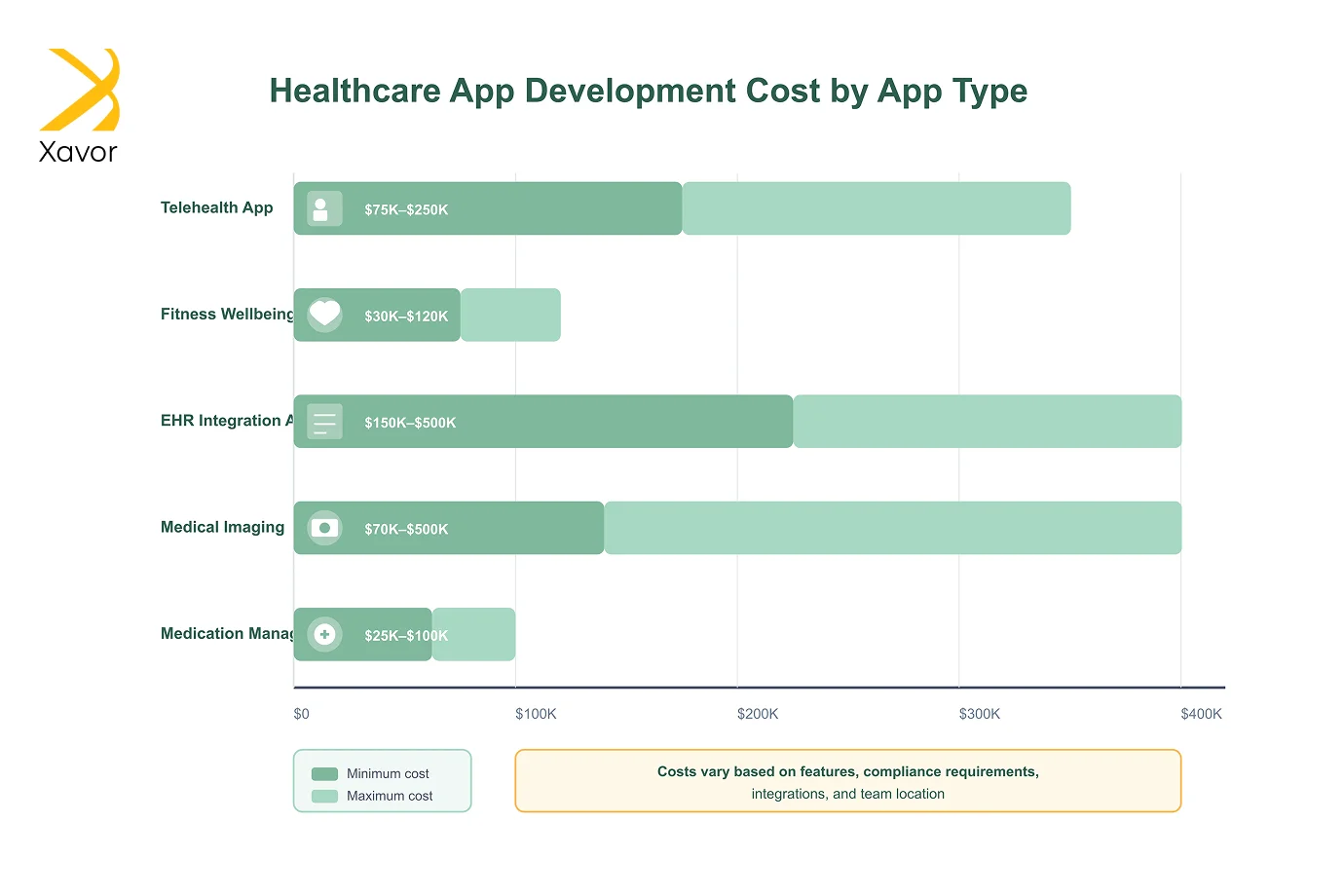
Healthcare app development costs by app type
Telehealth apps tend to be more expensive even as an MVP. That is because a telehealth app is actually five different healthtech products in one. It requires real-time streaming, integrations with EHRs, and stricter security and compliance. The margin for error in telehealth applications is close to none.
On the other hand, EHR software development and medical imaging apps comparatively cost less as an MVP, but they become more expensive with advanced features.
| App Type | Features | Estimated Costs (USD) |
| Telehealth app | Video consults, chat, payments, remote monitoring | $75,000 – $250,000 |
| Fitness and wellbeing app | Activity tracking, wearable integration, push notifications | $30,000 – $120,000 |
| EHR app | Patient records, clinical documentation, e-prescriptions, role-based access, interoperability | $150,000 – $500,000 |
| Medical imaging app | DICOM viewer, image upload/storage, radiology workflow support, PACS integration, secure sharing | $70,000 – $500,000 |
| Medication management app | Medication list & schedule, reminders, adherence tracking, refill requests, caregiver access | $25,000 – $100,000 |
How to create a healthcare app in 2026: Step-by-step guide
You might be thinking to yourself, “How can I launch a telehealth app?” This might sound oversimplified, but you can take the basic steps of building a functioning healthcare app with the right approach. We’re not talking about building an advanced, enterprise-level app for a hospital all on your own. You will need a hospital app development company for that.
But this step-by-step process is the blueprint that is followed more or less the same throughout the industry.
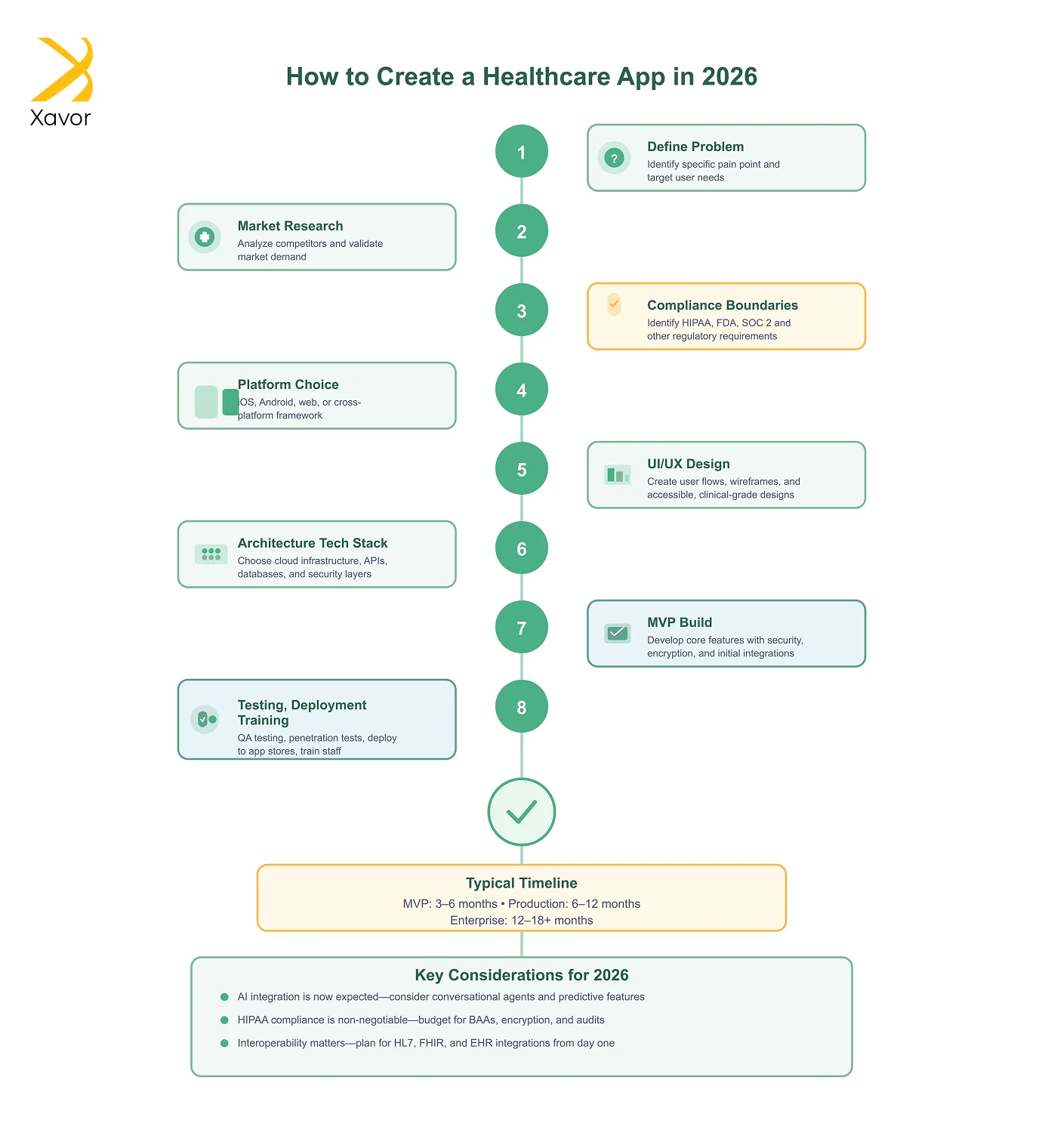
1. Understand the problem you’re solving
Before you reach out to a healthcare mobile app development company or even write a single line of code, you must have your basics covered. What is the pain point that you’re trying to resolve? And who is suffering from it? Is it the patients, providers, or the healthcare organization?
It has to be something real because in healthcare, building the wrong solution wastes the time of patients and providers, which is as precious as money.
2. Study the market
The healthcare market is your best teacher. Look at what already exists, and where are the gaps that you can exploit? Healthcare is full of apps that tried to be special and ended up being ignored.
The textbook way of analysing the market is by doing competitor research, following patient reviews, and keeping an eye out for healthcare publications and journals. These resources help you identify gaps, so you can define your unique value proposition.
3. Know your compliance boundaries
You need to figure out what type of patient data the app will be handling and what laws apply to it ASAP. This shapes your app architecture from day one. If you ignore compliance requirements early on, you get an expensive rebuild later.
Here is a table showing the common regulatory laws that are applicable to healthcare apps in most situations:
| Regulation | Region Applied | Covers |
| HIPAA | United States | Business and organizations handling protected health information |
| GDPR | EU/UK | Designates healthcare data as special category, requiring stricter conditions and safeguards |
| PDPA | Singapore | Governs personal data, and sector guidance specifically for healthcare |
4. Choose your platform
Next, you need to decide whether you want to target just one mobile platform or multiple. If your users are mostly on Android, then just focus on that. But if you want to capture as many users as possible, go for cross-platform application development. This way, you can target both Android and iOS with equal results.
5. Focus on UI/UX
Good UI/UX services are extremely important in healthcare apps to ensure providers or patients use it correctly, and it helps in the care experience. The last thing a patient needs in their healthcare app is a clunky user interface when they’re facing health difficulties.
Therefore, design healthcare apps so that they’re easy for both tech-savvy users and elderly patients. And if it’s a provider-facing app, it must not confuse caregivers because they are already working under extreme pressure.
4. Choose the right architecture
The right architecture and tech stack are one of the most important decisions in healthcare app development. Currently, most healthcare mobile app development services follow a modular, API-first approach in developing healthcare apps.
It helps them to add features without breaking anything and connect to EHRs, labs, devices, and other systems.
5. Develop an MVP
Building a full app healthcare app all at once is risky and expensive. Any professional healthcare mobile app development company first builds an MVP to test real-world workflows early.
This helps you spot usability issues, adoption problems, and operational friction before your app is fully developed. And this is an iterative process to improve what works and fix what doesn’t.
6. Test before deploying
Healthcare app testing proves that the app is safe and reliable before real people use it. It is more than just fixing bugs because sensitive patient data is involved.
In other industries, a few issues after launch are annoying. But in healthcare, the same issues can lead to privacy breaches and clinical errors.
Moreover, healthcare data is one of the most valuable targets for attackers, so security must be tested seriously. It should be repeated throughout development, because every new feature can introduce new risks.
7. Deploy and train users
The best way of deploying a healthcare app is to roll it out in phases. Start with a controlled pilot, monitor performance closely, and train the users of the app properly. Even a perfectly designed and developed healthcare app fails if people don’t know how to use it.
You can train your users with structured onboarding, documentation, and guides, and ongoing support. Once your app is proven stable and compliant, you can focus on expanding its user base.
Conclusion
We are in an era where a screen can influence a diagnosis, and an algorithm can shape clinical priorities. Healthcare apps operate in both controlled environments of hospitals and messy conditions of home settings. But anxiety, urgency, and pressure are constant. Therefore, a healthcare mobile app development company has to develop something closer to a care companion. And every design choice becomes a subtle form of guidance.
Xavor’s mobile app development services design solutions that upgrade the relationship between people and care. With over two decades of healthcare experience, we respect how fragile health truly is, and how much trust it takes to hand it over to technology.
Contact us at (email protected) to talk to our experts who will help you create something that is truly dependable.
About the Author

Umair Falak is the SEO Lead at Xavor Corporation, driving organic growth through data-driven search strategies and high-impact content optimization. With hands-on experience in technical SEO and performance analytics, he turns search insights into measurable business results.
FAQs
To launch a telehealth app, start by defining the care workflow and confirming compliance requirements like HIPAA/GDPR. Then build an MVP, test security and performance thoroughly, and roll out through a pilot before scaling with EHR/device integrations.
A strong MVP should include user onboarding, appointment scheduling, secure video consultations, chat, and basic admin controls, plus encryption and audit logging for safety and compliance.
Most healthcare apps must meet HIPAA in the US for handling PHI, GDPR in the EU/UK for sensitive health data, and may also need FDA oversight if the app functions as medical software.